
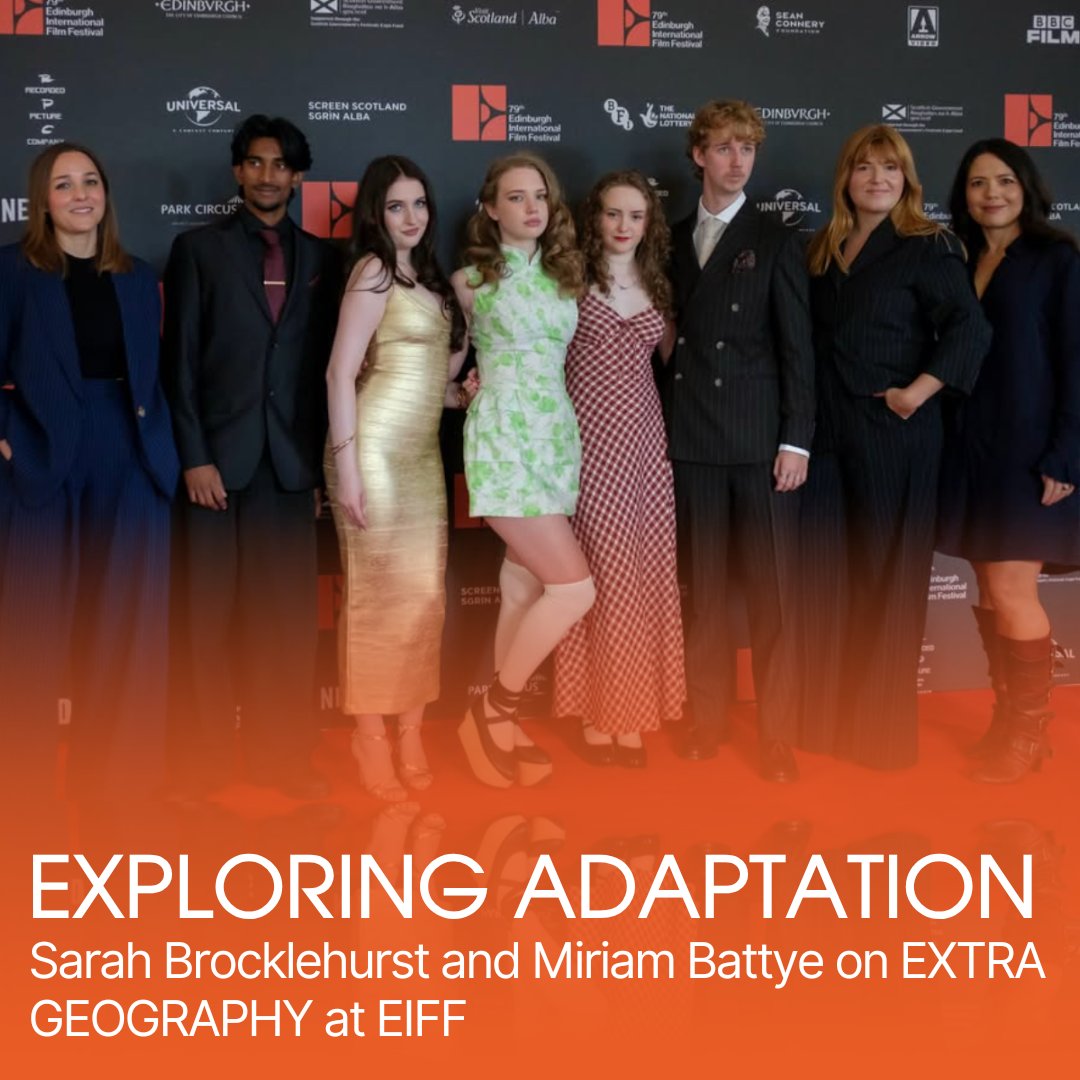
At this year’s Edinburgh International Film Festival, a panel exploring the art of adaptation brought together producers, writers and filmmakers to discuss the journey from page to screen.
Among the films at the centre of the conversation was EXTRA GEOGRAPHY, based on a short story by FWA client Rose Tremain. The panel featured Sarah Brocklehurst and Miriam Battye, alongside Jay Parini and Marc Turtletaub, whose film BORGES AND ME was also discussed.
The conversation touched on one of the perennial questions around adaptation: what makes a piece of writing lend itself to the screen?
For Sarah Brocklehurst, the answer isn’t necessarily a straightforward or traditionally cinematic story. She explained that she is often drawn to literary work that can inspire a personal and distinctive interpretation:
“I’m looking for material that will inspire perhaps quite a personal interpretation, adaptation of that source.”
She went on to describe how, particularly when looking for feature material, she can be drawn to writing that is poetic, experimental or challenging. Rather than making adaptation more difficult, these qualities can offer a filmmaker something rich to respond to and translate into a cinematic language.
EXTRA GEOGRAPHY provided a particularly interesting example. Originally a short story, Tremain’s work is vivid and evocative, with a precision that gave the filmmakers a strong foundation while still leaving room for interpretation.
Miriam Battye discussed the particular challenges and opportunities of adapting a short story, noting that the process differs from adapting a novel. Rather than having to condense a large body of material, the task can be about finding ways to expand what is already there while retaining the essence of the original.
For EXTRA GEOGRAPHY, the short story provided what Miriam described as a very strong backbone. The film retains key moments from Tremain’s story, while expanding the world around them and bringing the characters and their relationships more fully to life.
One of the most striking aspects of the discussion was the emphasis on the relationship between the original work and its adaptation. Miriam spoke about the importance of approaching the source material with respect, while recognising that adaptation is ultimately a creative process in its own right.
“It’s the relationship. And the author, I think, is really exciting.”
That relationship was particularly important on EXTRA GEOGRAPHY. Rose Tremain was closely involved throughout the production, with Sarah keeping in touch and updating Rose throughout the film. Rose’s involvement allowed the adaptation to remain connected to the original story while becoming its own piece of work.
Miriam also spoke about Tremain’s writing with admiration, describing her as an “extraordinary, precise writer” and highlighting the intensity and specificity of the dialogue between the two young women at the heart of the story.
That precision became an important part of the adaptation. Rather than attempting to replicate the short story word for word, the filmmakers looked for ways to preserve its emotional and thematic qualities on screen.
The panel also explored the question of fidelity – and whether an adaptation should even aim to be completely faithful to its source.
For EXTRA GEOGRAPHY, the answer was less about literal translation and more about identifying what was essential to the story. The film retains the central experience of the original short story while allowing the filmmakers to explore its characters, setting and emotional world in a different medium.
As the discussion made clear, there is no single formula for adapting a literary work. A short story can provide a concentrated idea, a character, a moment or an entire world, and filmmakers can respond to that material in very different ways.
For Sarah, that is part of the appeal of literary adaptation: the opportunity to discover something in a piece of writing and then find the right creative team to bring a new interpretation of it to the screen.
EXTRA GEOGRAPHY is a wonderful example of that process – a short story by Rose Tremain transformed into a feature film while retaining the precision, atmosphere and emotional intensity of its source.
The film received its UK Premiere at the Edinburgh International Film Festival, with its wider release following on 2 October.